
Stephen Hawking in Love with New COSMOS Intel Xeon-based Supercomputer
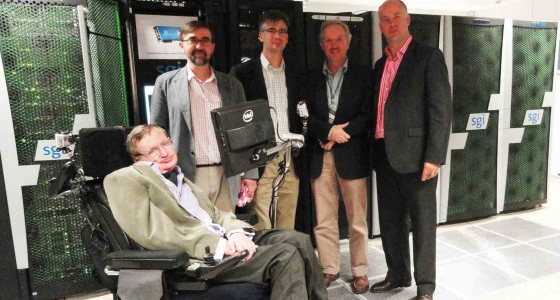
Particle physics will never be the same again. Just ask Stephen Hawking who is drooling over the installation of a new Intel Xeon supercomputer called COSMOS at the Distributed Research Utilizing Advanced Computing (DiRAC) facility, part of Cambridge University.
The powerful high-performance computer uses 1,856 Xeon E5 processing cores as well as 14.5 TB of globally shared memory and will be focused on computations that ‘advance our understanding of the origin and structure of the Universe.’
Midphase has also released a new lineup of Xeon E5 dedicated servers to its hosting mix, which, in some instances, boosts performance by 80%.
Meanwhile, Cambridge University said that COSMOS would be upgraded at a later point in time with 31 Xeon Phi coprocessors. The SGI Altix UV2000 cluster is already Europe’s largest share memory system.
COSMOS was founded in January 1997 by a consortium of leading UK cosmologists, brought together by Stephen Hawking and is currently funded by SGI, Intel, HEFCE and PPARC.
According to COSMOS, their platform is at the forefront of (distributed) shared memory HPC technology (as were the SGI Origin systems preceding it).
“It allows both shared memory and distributed memory (MPI) cosmology codes to be run with equal ease and with great flexibility and reliability. It operates a single system image across all processors and memory, creating a close similarity to an ordinary Linux workstation, and provides a particularly attractive environment for young researchers acquiring HPC experience.”
The above is another example of the extraordinary partnership between Intel-based Xeon processors and the Linux operating system, which form a critical cornerstone of Midphase hosting datacenters.
According to COSMOS, their research areas with regards the new supercomputer are the following:
- The origin of the Universe in a Hot Big Bang
- The cosmic microwave background radiation
- The formation of large-scale structure
Since the COSMOS launch in 1997, consortium members have published over 400 papers based on research using the central supercomputer or linked servers.